
Microsoft announced the Microsoft Dev Box during their recent conference. Over the last Construct convention, Microsoft introduced the Microsoft Dev Field. This new cloud service offers builders with safe, coding-ready developer workstations for hybrid groups of all sizes. With the brand new service, the corporate goals to make it simple for builders to shortly entry a pre-configured setting with all of the instruments and assets to jot down code.
Growth organizations can create and maintain Dev Field photographs themselves, with all the developers’ devices and dependencies to assemble and run their functions via way of means of making use of Microsoft Dev Field. As properly as, growth agencies can encompass software deliver codes and binaries which can be generated nightly, allowing developers to run and understand the code right away without being equipped for extended rebuilds. Development teams can consist of their utility supply code and nightly constructed binaries, permitting builders to at once to begin running and expertise the code without looking forward to lengthy re-builds.
It’s no secret that it can often be quite a bit of a process for developers to set up a new physical machine according to their needs. Microsoft argues that with the new Dev Box, IT teams can give newly onboarded developers easy access to a standard development environment without having to configure their own machine. Meanwhile, more senior developers who may be working on different projects — all with their own configurations and conflicting dependencies — can use multiple Dev Boxes to get their work done. And at the same time, IT regains control since the Dev Boxes are integrated with Windows 365 and management tools like Intune and the Microsoft Endpoint Manager.
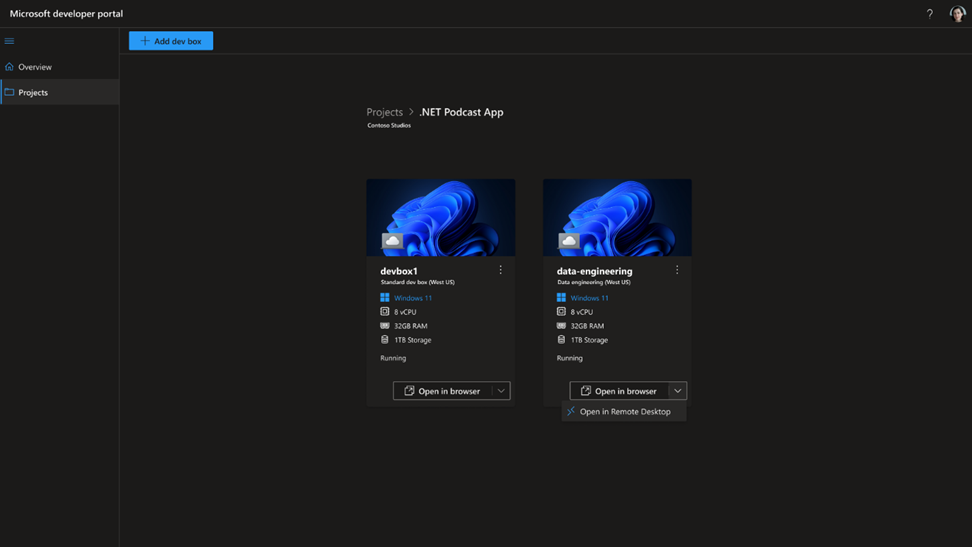
This is not the first time Microsoft has made virtual development environments available to developers. Earlier this year, the company also launched its Azure Game Development Virtual Machine into preview. The use case here is obviously a bit different, but the idea is pretty much the same. Developers can set up their boxes as needed, with any IDE, SDK or internal tools they need (as long as it runs on Windows) and target any platform their tools support.
The developer workstation is being modified
The dev workstations include an excess of challenges. New developers can spend days putting in a working surroundings and weeks earlier than they make their first commit. Senior developers regularly work throughout a couple of initiatives that may deliver conflicting dependencies and hamper their dev workstation. And we’ve all made an alternate that unexpectedly left us with damaged surroundings. With Microsoft Dev Box, dev groups create and maintain Dev Box pictures with all of the tools and dependencies their devs want to construct and run their applications. Teams can consist of their application source code and nightly constructed binaries, permitting devs to right now begin strolling and expertise the code while not having to watch for lengthy re-builds.
“Developers stay in control of their Dev Boxes with a developer portal that enables them to create and delete their Dev Boxes for any of their projects. Developers can create Dev Boxes to experiment on a proof-of-concept, keep their projects separate, or even parallelize tasks across multiple Dev Boxes to avoid bogging down their primary environment,” Microsoft explains in today’s announcement. “For devs working on legacy apps, they can maintain Dev Boxes for older versions of an application to quickly create an environment that can reproduce and diagnose critical customer issues as they emerge.”
Microsoft Dev Box supports any developer IDE, SDK, or internal tool that runs on Windows. Dev Boxes can target any development workload you can build from a Windows desktop and are particularly well-suited for desktop, mobile, IoT, and gaming. You can even build cross-platform apps using Windows Subsystem for Linux.
Developing Dev Teams
The Dev Box, according to Microsoft, guarantees that developers have the necessary tools and resources at all times, based on project, work, and even role. Dev teams choose from a variety of SKUs when designing Dev Boxes to define the proper level of computation for each project and immediately scale up aging physical hardware. Thanks to Azure Active Directory integration, teams can quickly onboard new team members by assigning them to Azure Active Directory groups that provide them access to the Dev Boxes they require for their projects.
Dev teams ensure remote team members enjoy a high-fidelity experience and gigabit connection speeds wherever they are in the world by putting Dev Boxes in the developer’s local region and connecting over the Azure Global Network. Dev teams can tighten network security while outsourcing to external teams by defining role-based permissions that provide internal developers with more flexibility while limiting access for external contractors.
Security & Management
IT administrators can use Azure Active Directory to put up sophisticated access controls for Dev Box security. For Dev Boxes that access sensitive source code and client data, IT admins can set up conditional access policies that require users to connect through a compliant device, demand multifactor authentication (MFA), or implement risk-based sign-in policies.
Importantly, Microsoft Dev Box isn’t just for developers; because it’s integrated with Windows 365, IT managers can easily manage Dev Boxes alongside Cloud PCs in Microsoft Intune and Microsoft Endpoint Manager. IT admins may send zero-day patches to all devices throughout their enterprise using Intune’s expedited quality updates. If a developer’s Dev Box is hacked, IT administrators can isolate it while assisting the developer in reinstalling the software on a fresh Dev Box.
Conclusion
To keep costs down, developers can obviously spin their machines down at night and start them up in the morning. And to manage those costs across teams, Microsoft will also offer a single view to see all of a team’s boxes.
Microsoft Dev Box is now in private beta and will be released to the general public in the coming months. Visit here to learn more about Microsoft Dev Box and see demos.